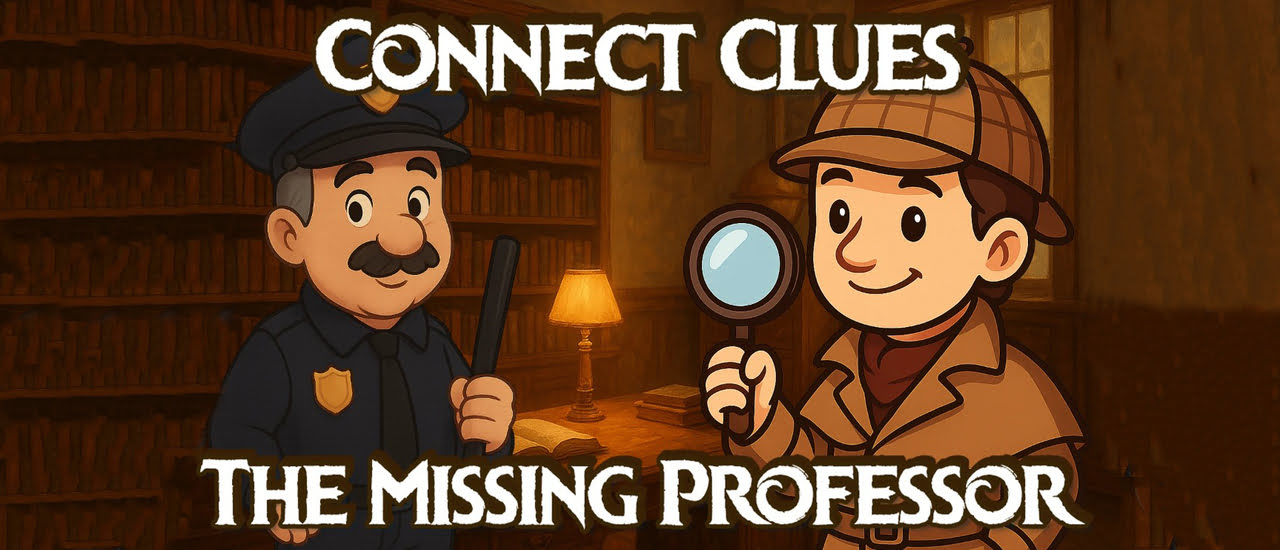
Connect Clues – The Missing Professor is a story-driven puzzle game that blends classic merge mechanics with a slow-burning detective mystery. You follow Inspector Hale and Detective Crane as they investigate the sudden disappearance of Professor Eldridge, a brilliant but eccentric historian whose office was left in total chaos. Nothing about this vanishing feels normal, and every clue you uncover pushes the case in a new direction.
The game keeps things simple on the surface but steadily builds depth. Each turn introduces a new clue that drops onto the board. Your job is to position it carefully, merge matching clues, and unlock more advanced discoveries. As the clues evolve, so does the narrative. Documents, objects, and hidden connections begin to reveal what really happened to the professor. It is easy to start playing, but the mystery rewards patience and smart planning.
How to Play
Each round begins with a fresh clue appearing at the top of the screen. You can move this clue left or right before releasing it onto the board. Once dropped, it falls into place and may collide with other clues already on the grid.
When two identical clues touch, they merge into a new and more advanced clue. These upgraded clues unlock story details, new leads, and progress in the investigation. Your goal is to keep merging efficiently so you do not run out of space while still pushing the story forward.
The Investigation Log is your constant companion. It tracks every discovery you make and helps you understand how different clues connect to the bigger mystery. You can open it at any time using the book icon at the top of the screen.
Controls
Mouse Controls
- Move the mouse left or right to position the falling clue
- Click and release to drop the clue onto the board
- Click the book icon to open the Investigation Log
Touch Controls
- Swipe left or right to move the clue
- Lift your finger to drop the clue
- Tap the book icon to view the Investigation Log
Keyboard controls are not used in this game.
Tips & Strategies
1. Do not rush your drops. A poorly placed clue can block future merges and waste valuable space.
2. Focus on creating chain merges. Setting up two merges in one drop saves space and accelerates progress.
3. Keep similar clues grouped together. Scattered clues are harder to combine later.
4. Use the Investigation Log often. It helps you understand which clues are worth upgrading next.
5. Watch the board height. If the grid fills too high, you lose room to maneuver and the puzzle becomes much harder.
6. Sometimes it is better to delay a merge to create a better setup for future clues.
One of the biggest mistakes players make is treating Connect Clues like a pure merge game and ignoring the board layout. Most early losses happen because players drop clues too quickly without thinking two or three moves ahead. The game rarely punishes you immediately, which creates a false sense of safety.
What separates average players from good ones is board discipline. Skilled players leave intentional gaps and build small clusters of matching clues instead of chasing instant merges. This gives them flexibility when unexpected clues appear. Another common misunderstanding is assuming every merge is good. Sometimes holding off on a merge keeps the board stable and prevents overcrowding.
The mystery unfolds at a steady pace, so there is no need to rush. Taking a calm, methodical approach not only keeps your board clean but also makes the story more satisfying as connections reveal themselves naturally.
Similar Games
- The Rooms-Escape Challenge – Solve clever puzzles and escape a locked room using observation and logic.
- Help Me: Tricky Brain Puzzles – Tackle creative brain teasers that reward unconventional thinking.
- Stickman Troll Thief Puzzle – Use smart moves and timing to solve humorous, logic-based challenges.
FAQs
Is Connect Clues – The Missing Professor free to play?
Yes, you can play it online for free in your browser.
Can I play this game on mobile?
Yes, the game supports touch controls and works smoothly on mobile devices.
Is this game more about story or puzzles?
It balances both. The puzzles drive the story, and the story gives meaning to each puzzle.
Is the game difficult for beginners?
It starts off easy, but managing space and planning merges becomes more challenging over time.
Do I need fast reflexes to play?
No. The game rewards careful thinking and planning rather than speed.